SpinFever Payment Methods in Australia
 Available in AU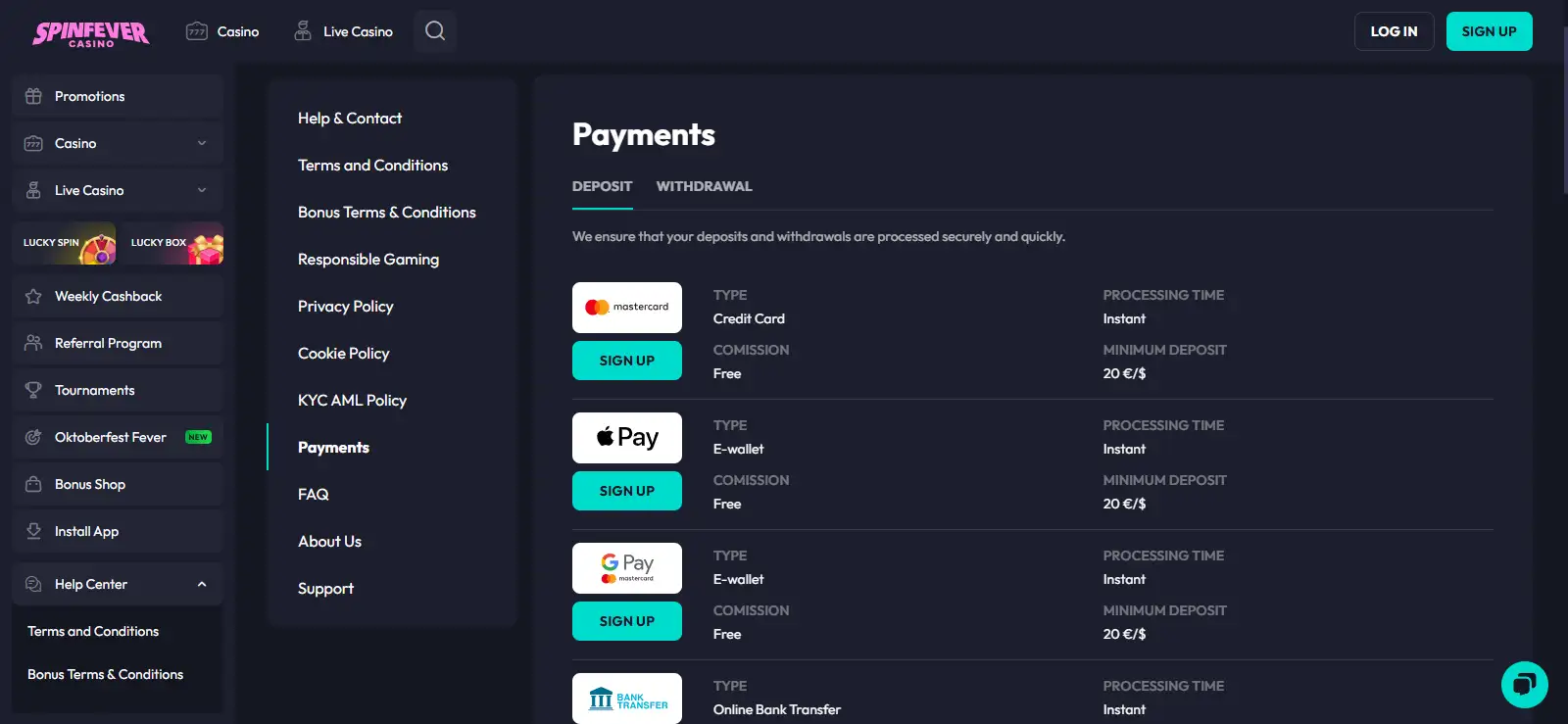
SpinFever’s current Australia-facing payments page lists Mastercard, Apple Pay, Google Pay, bank transfer, Paysafecard, MiFinity, eZeeWallet and a group of cryptocurrencies including Bitcoin, Ethereum, USDT, Dogecoin, Litecoin and Bitcoin Cash. The table separates deposits from withdrawals, which is important because a method being available to deposit does not automatically mean it is the best or even an available route for cashing out.
For Australian readers, the other key distinction is between what is popular locally and what SpinFever actually publishes. PayID has become widely used in Australia, but it is not listed on the current SpinFever AU payments table. It should therefore not be presented as a current SpinFever deposit method. Cards and mobile wallets are a more direct match between Australian payment habits and the methods currently shown by the brand.
Table of Contents
- Payment methods currently published by SpinFever
- Deposit minimums: cashier minimum versus bonus minimum
- Cards and mobile wallets fit common Australian payment habits
- PayID is popular in Australia but is not listed by SpinFever
- Bank transfer: useful, but deposits and withdrawals differ
- Crypto deposits and withdrawals
- Deposits are not the same as withdrawals
- How bonuses can change the payment decision
- Choosing between card, wallet and crypto routes
- Practical payment checklist for Australian users
- Where the payment information comes from
Payment methods currently published by SpinFever
The current AU payments page groups methods into cards, e-wallets, online bank transfer and crypto. The deposit side shows Mastercard, Apple Pay, Google Pay, bank transfer, Paysafecard, Bitcoin, Ethereum, USDT, Dogecoin, Litecoin, Bitcoin Cash, Postepay, eZeeWallet and MiFinity. This is a published cashier list, not a guarantee that every method will appear for every user, issuing bank or account.
| Category | Methods currently shown | What to verify in your cashier |
|---|---|---|
| Card | Mastercard | Issuer acceptance, transaction approval and account eligibility |
| Mobile wallet | Apple Pay, Google Pay | Supported card, device and wallet availability |
| Bank transfer | Bank Transfer | Exact banking route, limits and whether withdrawals use the same path |
| Prepaid and e-wallets | Paysafecard, MiFinity, eZeeWallet, Postepay | Regional availability and whether the method supports withdrawal |
| Crypto | BTC, ETH, USDT, DOGE, LTC, BCH | Network, dynamic minimum, wallet address and supported withdrawal route |
SpinFever’s page labels the listed deposit methods as fee-free on the brand side and shows instant processing for the deposit entries. That describes the information published by SpinFever, not every cost that might exist outside the casino. A bank, card issuer, wallet service or crypto network can apply its own charges, exchange spreads or restrictions.
Deposit minimums: cashier minimum versus bonus minimum
The payments table currently shows 20 EUR/USD as the standard displayed minimum for many fiat methods, while crypto minimums are dynamic in the deposit cashier. Separately, SpinFever’s bonus terms set a 30 AUD equivalent minimum for welcome-package deposits. These are different concepts and should not be collapsed into one number.
The cashier minimum answers: “What is the smallest transaction this payment route currently accepts?” The bonus minimum answers: “What deposit is required to activate this promotion?” A deposit can therefore be large enough for the cashier while still being too small for a particular bonus. Conversely, a promotion can require more than the basic payment minimum.
For Australian users, the safest process is to check the amount shown in AUD in the logged-in cashier and then compare it with the exact promotion terms before confirming the transaction. This avoids relying on currency equivalents shown in a public table when the account interface may present a localised amount.
Cards and mobile wallets fit common Australian payment habits
The Reserve Bank of Australia’s 2025 Consumer Payments Survey found that cards remained the most widely used consumer payment method in Australia. Debit cards alone accounted for around half of consumer payments, and card use remained strong across transaction sizes. The same survey also found growing use of mobile wallets, with 43% of consumers using a mobile device for a contactless payment during the diary week.
That wider Australian context makes Mastercard, Apple Pay and Google Pay familiar options for many users. It does not guarantee that a particular bank will authorise a gambling-related transaction or that a wallet will appear for every SpinFever account. Payment acceptance can depend on the issuer, the underlying card, risk controls and the specific checkout route presented to the user.
In practice, a published card or wallet method should be treated as a route that SpinFever offers, while the final approval decision still sits with the payment chain. If a transaction is declined, repeatedly retrying the same method is less useful than checking the issuer message, the cashier options and any bank-side restrictions.
PayID is popular in Australia but is not listed by SpinFever
PayID deserves an explicit note because it is now a mainstream Australian payment tool. RBA survey data published in 2026 report that around 50% of respondents had used PayID in the prior year, up from 32% in the 2022 survey. Awareness was around 80%. That makes PayID an obvious method for an Australian reader to look for when checking an online cashier.
However, the current SpinFever AU payment table does not list PayID. This guide therefore does not describe SpinFever as supporting it. Local popularity and brand-specific availability are separate facts. The same principle applies to any other familiar Australian payment option that is not shown in the cashier or a current SpinFever payment source.
This distinction is useful beyond PayID. A payment guide should describe the operator’s actual published methods first, then use local payment context only to explain why readers may expect certain options. It should not reverse that logic by assuming a locally popular method must be accepted by the casino.
Bank transfer: useful, but deposits and withdrawals differ
Bank transfer appears on SpinFever’s current AU payments page. On the deposit side, the public table shows it as an online bank transfer route with instant processing and a standard fiat minimum display. On the withdrawal side, the same page presents bank transfer differently, including a longer processing window and a higher displayed minimum. Those withdrawal specifics belong in the dedicated withdrawal guide because they can change more readily than the broad fact that bank transfer is supported.
The practical lesson is that the same payment label can behave differently depending on transaction direction. Deposit availability does not establish withdrawal speed, withdrawal minimums or the exact bank route. Users who care about cash-out mechanics should read the SpinFever withdrawal Australia guide before choosing a deposit path solely for convenience.
Crypto deposits and withdrawals
SpinFever’s AU payments page currently lists six cryptocurrencies: Bitcoin, Ethereum, USDT, Dogecoin, Litecoin and Bitcoin Cash. The public deposit table describes crypto minimums as dynamic, meaning the account cashier should be treated as the current source for the amount needed at the time of a transaction.
Crypto creates a different set of checks from cards or wallets. The currency symbol alone is not enough. A user should confirm the supported network, the destination address, any memo or tag requirements, the amount being sent and the network fee before approving a transfer. Sending assets on the wrong network can create recovery problems that do not exist with a standard card payment.
It is also important not to equate crypto support with anonymity or exemption from account checks. Payment type and identity verification are separate parts of an account relationship. SpinFever can support crypto while still applying account verification requirements. If verification is relevant to your withdrawal planning, use the site’s dedicated KYC guide rather than assuming a crypto transaction avoids those steps.
Deposits are not the same as withdrawals
A strong payment-method comparison separates money-in from money-out. SpinFever’s own payments page does this with separate deposit and withdrawal views. The available route, processing description and minimum can differ between the two. Some methods are primarily designed for deposits, while others can support both directions depending on account and region.
This is why the best deposit method is not automatically the method with the fastest published deposit time. If you expect to withdraw to a specific route later, check that route first. A small amount of planning before the first deposit can reduce friction when the balance is ready for cash-out.
The dedicated withdrawal guide covers that next step in detail, including the role of verification and method-specific constraints. This page intentionally stops short of presenting exact withdrawal limits or exact processing times as durable facts because those details are more sensitive to change and require their own current verification.
How bonuses can change the payment decision
A payment method can be technically available while a deposit still fails to qualify for the promotion you wanted. SpinFever’s general bonus terms set a 30 AUD equivalent minimum for welcome-package deposits, and individual offers can have their own rules. The payment page therefore answers only part of the decision.
Before depositing for a promotion, check the SpinFever bonus Australia page and the current offer terms. Confirm the qualifying amount, code, wagering and any method restrictions before the transaction. This prevents a common mistake: choosing a cashier route first and only checking the bonus conditions after the deposit has already been made.
Choosing between card, wallet and crypto routes
The method list becomes more useful when it is translated into decision criteria. A card is usually the simplest choice for a user who wants a familiar payment flow and does not need a separate wallet balance. Apple Pay and Google Pay can reduce the amount of card data entered into the casino interface, but the underlying card and issuing bank still determine whether the transaction is approved. An e-wallet can separate the casino transaction from the user’s main card statement, although the wallet itself can have funding, verification and withdrawal rules of its own.
Crypto is different again. It removes the card issuer from the payment path, but it adds wallet management, network selection and asset-price considerations. A bank transfer can suit users who prefer account-to-account movement, but the public SpinFever table shows that the withdrawal side is not identical to the deposit side. There is therefore no universally “best” method from the published list. The useful choice depends on whether your priority is familiarity, account separation, withdrawal routing, speed, or control over the payment instrument.
Whichever route you choose, verify the transaction details in the cashier at the moment of deposit. Public payment tables are useful for identifying available categories, but the logged-in cashier is the better place to confirm the exact method, currency display and current minimum for your account.
Practical payment checklist for Australian users
- Open the logged-in cashier and confirm the method is actually available for your account.
- Check whether the account is displaying the transaction in AUD and confirm the amount before submitting.
- Distinguish the cashier minimum from any higher minimum required by a bonus.
- For cards and wallets, consider whether your issuer permits the transaction category.
- For bank transfer, check the exact banking instructions and do not assume deposit and withdrawal timing are identical.
- For crypto, verify the asset, network, address and current dynamic minimum before sending funds.
- Do not assume PayID support merely because it is widely used in Australia.
- If withdrawal convenience matters, check the withdrawal route before choosing the deposit method.
- Keep transaction confirmations and cashier references until the payment has settled.
Where the payment information comes from
The SpinFever-specific method list appears on the current SpinFever Australia payments page. Australian consumer payment context comes from the Reserve Bank of Australia’s 2025 Consumer Payments Survey analysis, published in May 2026. These sources answer different questions: SpinFever’s page identifies methods the brand currently publishes, while the RBA describes payment behaviour in Australia generally.
For a broader brand overview, return to the SpinFever Casino Australia Review 2026. If you have not yet created an account, the SpinFever registration Australia guide explains the account setup sequence.
Written by the editors at Spin Fever Casino.